Beginner. 1.25 hours, 15 lessons.
Python Basics
Learn Python from zero with small programs from student life. Marks, grades, bills, passwords and a mini student-record app. Run every program right on our website.
Watch the intro, free
No sign up and no email required. A short introduction to the idea the whole course is built on.
Python Basics, free intro
What the intro shows
The complete first lesson, free: what Python is, why every BCA and B.Tech student should learn it, and your first program, typed and run live on our website, in Google Colab and in VS Code. Nothing to install, and no programming background needed.
What you will be able to do
- Write and run Python on our website, in Google Colab and in VS Code
- Use variables, data types, input, output and operators with confidence
- Make decisions with if, elif and else, and repeat work with while and for loops
- Write your own functions, and use modules like math and random
- Index, slice and change text with string methods
- Store data in lists, tuples, sets and dictionaries
- Read and write text and CSV files, and handle errors with try and except
- Make your own classes and objects, and build a mini student-record program
Who this course is for
First-year BCA and B.Tech students of every branch (CSE, IT, ECE, Mechanical, Civil and others) studying the “Python Programming” or “Programming for Problem Solving” paper. Also B.Sc Computer Science and IT students, polytechnic students, Class 11 and 12 Computer Science students, and anyone who wants to start coding with Python.
You do not need to know any programming. You do not need a powerful laptop. You do not need perfect English.
What makes this course different
Every example is from student life. A marks calculator, a grade checker, a shop bill, an electricity bill, a password checker, a word counter and a small student-record program. No difficult maths.
Run the code right on the lesson page. Under every video, the lesson’s programs are ready to run with one click, and there is an editor for your own code. No Google account, nothing to install. From Lesson 2 on, the videos use this same editor, so what you see is exactly what you get.
Every code has its output. Every program in the notes was run before it was printed, and the real output is shown under it. You always know what you should see.
Errors are shown on purpose. Every lesson makes one mistake on screen, reads the error and fixes it. Students who see the teacher make an error are less afraid of their own.
It follows the usual first-year syllabus. Five modules, three lessons each, in the order most universities teach them. See the full map below.
What you get
- 15 video lessons, 3 to 7 minutes each, about an hour and a quarter in total
- A Python editor on every lesson page, with the lesson’s programs ready to run
- A notes PDF of about 95 pages, watermarked in your name, yours to keep
- A 20-exercise practical workbook with model solutions
- A final test, graded the moment you submit it
- A verifiable certificate with a unique ID and a public verification page
- Lifetime access, including every future update to the course
How it matches your syllabus
Every topic of a typical first-year Python paper is taught in a lesson and has its own section in the notes.
- Module 1, Getting started with Python (lessons 1 to 3; notes 1.1 to 1.13): What Python is; installing Python, and IDEs such as VS Code; your first program; variables and data types; type conversion; print() and f-strings; input(); arithmetic, comparison, logical and assignment operators.
- Module 2, Decisions and loops (lessons 4 to 6; notes 2.1 to 2.12): Indentation; if, if-else, if-elif-else and nested if; while and for loops with range(); looping over text and lists; break, continue and pass; else with a loop; nested loops, patterns and the Fibonacci series.
- Module 3, Functions, modules and strings (lessons 7 to 9; notes 3.1 to 3.15): Defining and calling functions; parameters, arguments and return; default and keyword arguments; local and global scope; recursion; lambda; modules such as math and random; string indexing, slicing and methods.
- Module 4, Lists, tuples, sets and dictionaries (lessons 10 to 12; notes 4.1 to 4.11): Making and changing lists; list methods; list comprehensions; nested lists; tuples and unpacking; sets and set operations; dictionaries and looping through them; which data structure to use.
- Module 5, Files, errors and classes (lessons 13 to 15; notes 5.1 to 5.11): Writing, reading and appending text files; CSV files; errors and exceptions; try, except, else and finally; raising an exception; classes, objects, init and self; inheritance; a mini student-record project.
Curriculum
Every lesson title, before you pay.
1 Getting Started with Python 3 lessons
- Why Python, and your first program Free 7 min
- Variables, data types, input and output 6 min
- Operators and expressions 5 min
2 Decisions and Loops 3 lessons
- Decisions with if, elif and else 5 min
- Loops: while, for and range 7 min
- break, continue and nested loops 6 min
3 Functions, Modules and Strings 3 lessons
- Functions: parameters and return 5 min
- Scope, recursion, lambda and modules 5 min
- Strings: indexing, slicing and methods 5 min
4 Lists, Tuples, Sets and Dictionaries 3 lessons
- Lists and list comprehensions 5 min
- Tuples and sets 3 min
- Dictionaries 4 min
5 Files, Errors and Classes 3 lessons
- Reading and writing files 4 min
- Errors and exception handling 4 min
- Classes and objects, and a mini project 5 min
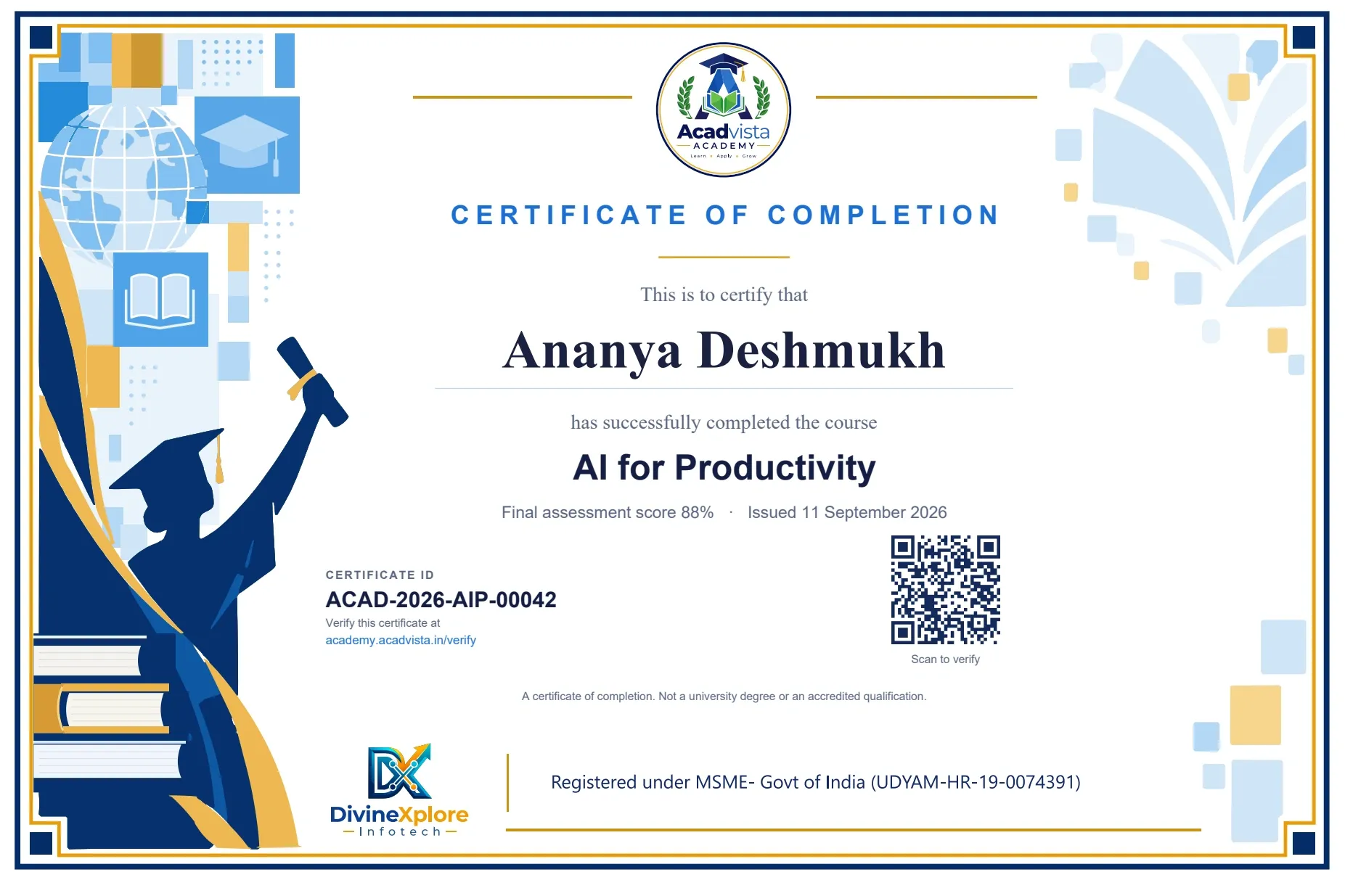
A certificate anyone can check
Pass the final test and your certificate is issued automatically, with a unique ID such
as ACAD-2026-AIP-00042
and a QR code. Anyone, including an employer, can verify it on this site without logging in.
Questions people ask before paying
I have never written code. Can I do this?
Yes. The course starts from zero and is written for first-year students, including students from Hindi-medium schools. If you can use WhatsApp and open a website, you can do this course.
Does it follow my university syllabus?
It covers the topics of the first-year Python paper at most universities (BCA, B.Tech "Python Programming" or "Programming for Problem Solving", B.Sc CS and IT), in the usual order. Basics, decisions and loops, functions and strings, lists, tuples, sets and dictionaries, and files, errors and classes. The notes have a table that maps each syllabus topic to its lesson. If your university's syllabus differs, check its list of topics against the map below.
Do I need a laptop or any software?
A basic laptop or desktop and an internet connection. Every lesson page has its own Python editor, so you can run code right on our website, with no Google account. Lesson 1 also shows Google Colab and Python with VS Code on your own laptop. Nothing to buy. A phone can run the ready-made programs, but a laptop is much better for typing code.
What language are the videos in?
Simple Hindi and English mixed, slowly and clearly. The notes are in simple English, with a New words box wherever a new term appears.
What exactly do I get?
Fifteen video lessons, a Python editor on every lesson page with that lesson's programs ready to run, a notes PDF watermarked in your name with the output of every program shown, a 20-exercise workbook with model solutions, a final test, and a verifiable certificate on passing.
Is the certificate recognised?
It is a certificate of completion from Acadvista Academy, with a unique ID that anyone can verify on this site without logging in. It is not a university degree or an accredited qualification, and we do not present it as one.
Can our college buy this for a whole batch?
Yes. Write to us with the number of students and we will send bulk pricing and a single invoice.
Still unsure? Ask us anything before you pay. We answer on WhatsApp, usually within the hour.
Ask on WhatsApp